
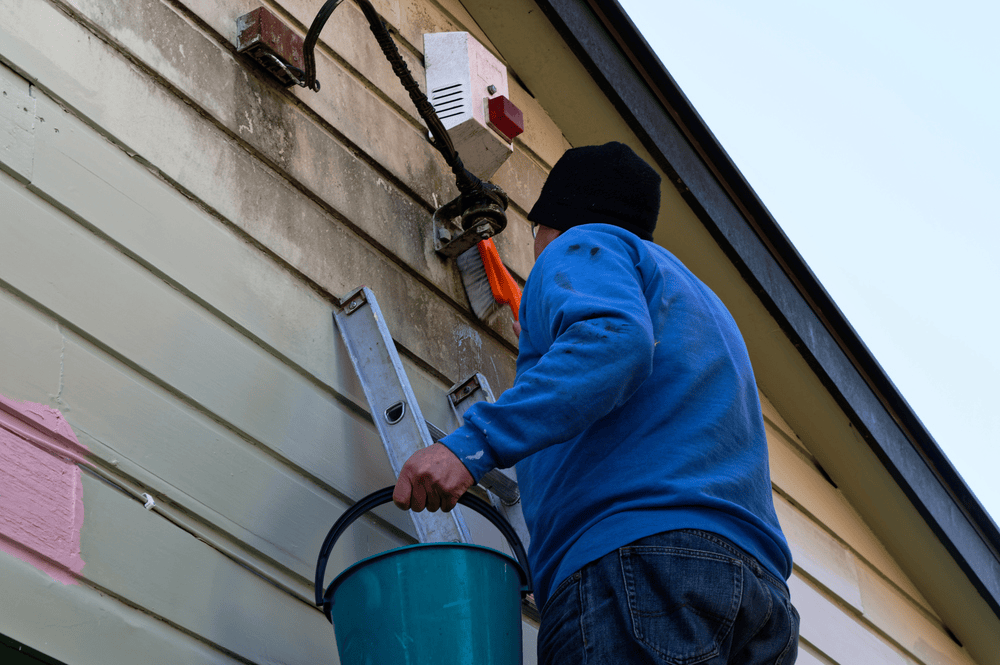
Here is how to prepare for exterior house painting in Easthampton, MA: inspect for rot and moisture, wash and fully dry the siding, scrape all loose paint, caulk only vertical joints, and spot-prime bare wood before the topcoat. Most Easthampton homes were built before 1978, so paid prep that disturbs more than 20 square feet of exterior paint must be done by a Massachusetts lead-safe licensed contractor.
- Prep, not paint brand, decides how long exterior paint lasts.
- Rot found mid-job is often billed extra, so get repair pricing in writing.
- Soft washing beats high-pressure blasting on old clapboards.
- Contractors on owner-occupied homes of one to four units must be state registered.
- Fall dew, not air temperature, limits when paint can go on.
- South and west walls fail first, so a partial repaint may be enough.
The most expensive exterior paint job is the one you pay for twice. In Easthampton, early peeling almost always traces back to prep, not the paint can. Many of Easthampton’s homes predate 1978, from Greek Revival houses in the Main Street Historic District to mill-era homes near Cottage Street.
Many carry decades of layered paint, and a quick scrape-and-paint job over that surface rarely lasts. This guide walks through the process the way our crews handle it on local homes.
What Should You Do Before Exterior House Painting? Start With an Inspection
Before any scraping or painting, walk the house and find rot, failed caulk, and water sources. The first step is an honest inspection, not a trip to the paint store. Push a screwdriver into windowsills, trim bottoms, and clapboard ends. Soft spots mean wood rot that must be repaired first. Wood, vinyl siding, and plaster each need different cleaning and primers.
Check Siding, Trim, and Windowsills for Wood Rot:
- Probe sills, fascia, corner boards, and the lowest courses of siding, where splash-back soaks the wood.
- Blisters usually mean moisture pushing from behind. Paint flaking off in sheets usually means poor adhesion.
- Try the tape test: press tape onto the old paint and pull it off. Any paint that lifts with the tape has to come off before painting.
Find the Moisture Source Before You Fix the Paint
The mistake that costs Easthampton customers the most is accepting an estimate that says “repairs as needed.” Scraping often exposes rot no one saw during the walkaround, and open-ended wording turns that into a surprise bill. Fix gutters and flashing first, and ask for per-board repair pricing plus a photo approval step before any carpentry begins.
Can You Just Paint Over Old Exterior Paint? Pressure Washing and Scraping, Done Right
No. Painting over peeling, cracked, or chalky paint just traps the failure under a new coat, and it telegraphs through within a season. Wash gently, let the siding dry fully, then scrape every bit of loose paint.
On older Easthampton clapboards, full-power pressure washing usually isn’t the move. A narrow nozzle at high pressure drives water into the end grain and behind the siding, and it scatters old paint chips across the yard. We use a low-pressure soft wash with a mildew cleaner, rinsed with a wide fan tip, over tarps that protect the work area. Pressure washing still has a place on sound vinyl siding.
Scraping Loose Paint Is Non-Negotiable
- New paint can only adhere as well as the layer beneath it.
- Use a paint scraper on flaking areas, a wire brush on crevices, and hand sand edges where old paint meets bare wood.
In Easthampton, this matters because most homes here fall into the pre-1978 group described above. Under Massachusetts lead-safe renovation rules, paid painting work that disturbs more than 20 square feet of exterior paint must be done by a licensed Lead-Safe Renovation contractor with a certified supervisor on staff.
Does Exterior Siding Need Primer? Caulking and Priming Done Right
Siding needs primer wherever bare wood, repairs, or chalky old paint are exposed. Caulking is where many guides on preparing an exterior house for painting go wrong. Clapboards are built to breathe, and many older Easthampton homes have no housewrap, so indoor moisture escapes through the laps.
Seal those horizontal seams, and the moisture gets trapped behind the paint, causing blisters and rot. Caulk only the vertical joints: butt joints, corner boards, and where siding meets window and door trim. Use a high-grade elastomeric or urethane-modified sealant.
When to Prime Bare Wood (Oil-Based vs. Acrylic Primers)
- Spot-prime bare wood soon after scraping, before it weathers again.
- Oil-based primers penetrate weathered wood and help block tannin bleed. Acrylic primers stay flexible and dry fast.
- Finish with a 100% acrylic latex paint, which flexes through freeze-thaw cycles.
Why Quality Materials Are the Most Cost-Effective Choice
Labor, not house paint, is usually the biggest part of an exterior bill, it’s the largest single line item in most professional painting quotes. That makes premium-quality materials one of the most cost-effective upgrades on the job, because the same labor buys a longer-lasting finish. Ask your painter to name the exact product line on the estimate.
How Long Should Exterior Surfaces Dry Before Painting?
Give washed siding at least 24 to 48 hours of dry weather, and confirm with a moisture meter. The final step before you pick up a brush is patience. Application temperature depends on the product, standard latex paints are typically rated down to 50°F, though a growing number of low-temperature acrylic formulas are rated as low as 35°F. Always check the can rather than assuming.
In the Connecticut River Valley, dew is the real limit. Siding facing Mount Tom or under big maples can reach the dew point before fresh paint sets. That leaves tan streaks, called surfactant leaching, and a weaker paint film.
Paint Color Selection and Dark Colors on Sunny Walls
Settling on a color months ahead, not on paint day gives you time to compare swatches in different light instead of rushing the decision. Dark colors absorb more heat, which shortens working time on south and west walls. On vinyl siding, a dark color can cause warping unless you choose a vinyl-safe paint color.
DIY or Hire Exterior House Painters in Easthampton, MA?
DIY can work on small, newer, one-story homes, but tall, older, or pre-1978 houses are safer and faster with licensed exterior house painters in Easthampton, MA.
What Professional Painters Bring: Scaffolding, Sprayers, and Speed
Professional painters bring scaffolding for second stories, containment for older homes, and a sprayer for faster paint application, then back-brush so the paint works into the grain. (If you want to see the prep mistakes that shorten a paint job’s life, we’ve broken those down separately in Common Painting Mistakes and How to Avoid Them.)
At Willard and Ward Pro Painting, we put the full prep scope in writing. You can browse recent exterior projects here or read what past customers say in our Google reviews.
Your Exterior House Painting Questions, Answered by Easthampton Painters
Late May through September is usually the most reliable window. What actually rules out a day isn’t the calendar, though it’s dew. Hold off on mornings with heavy dew or when rain is forecast within 24 hours, fall or not.
Primer gives the topcoat something consistent to bond to. Skip it on bare wood, repairs, or chalky old paint, and the new paint is more likely to peel or fail early, and tannins from the wood can bleed through the finish.
It depends on the product. Standard acrylic latex paints are generally rated down to 50°F; a number of manufacturers now sell low-temperature formulas rated for application down to 35°F, provided the surface stays above that threshold for a set number of hours afterward. Check the label on the specific product “cold weather” isn’t one number across every paint line.
Warranties usually cover peeling caused by poor prep or application, but most exclude damage from water getting in through roofs, gutters, or flashing. Paint manufacturer warranties are separate and may be denied if the product was applied incorrectly.
There’s no single number, exposure, prep quality, and the product all play a role. Peeling within two or three years isn’t normal wear; it signals a prep or moisture problem.
Request an Estimate for Exterior House Painting in Easthampton, MA
Ready to hand off the scraping, repairs, and ladder work? Request an Estimate with a full walkaround assessment of every side of your home for exterior house painting in Easthampton, MA, Northampton, and nearby towns. We will show you which walls need work now and which can wait. Call 413-240-4545 or book your estimate online.